
Many people entering the investment market in 2026 are asking a simple question:
How much money can I realistically make from investing today?
After years of market volatility, inflation pressure, and shifting interest rates, expectations around returns have changed significantly.
While financial media often highlights high-performing years or extreme gains, the reality for most investors is more stable—and more conservative.
Understanding realistic investment returns in 2026 is essential for making informed financial decisions.
📊 What “Investment Returns” Really Mean in 2026
Investment return refers to the percentage gain or loss on capital over a specific period.
In 2026, returns are influenced by multiple factors:
Interest rate cycles
Inflation trends
Stock market volatility
Global economic uncertainty
Sector rotation (tech, energy, AI, etc.)
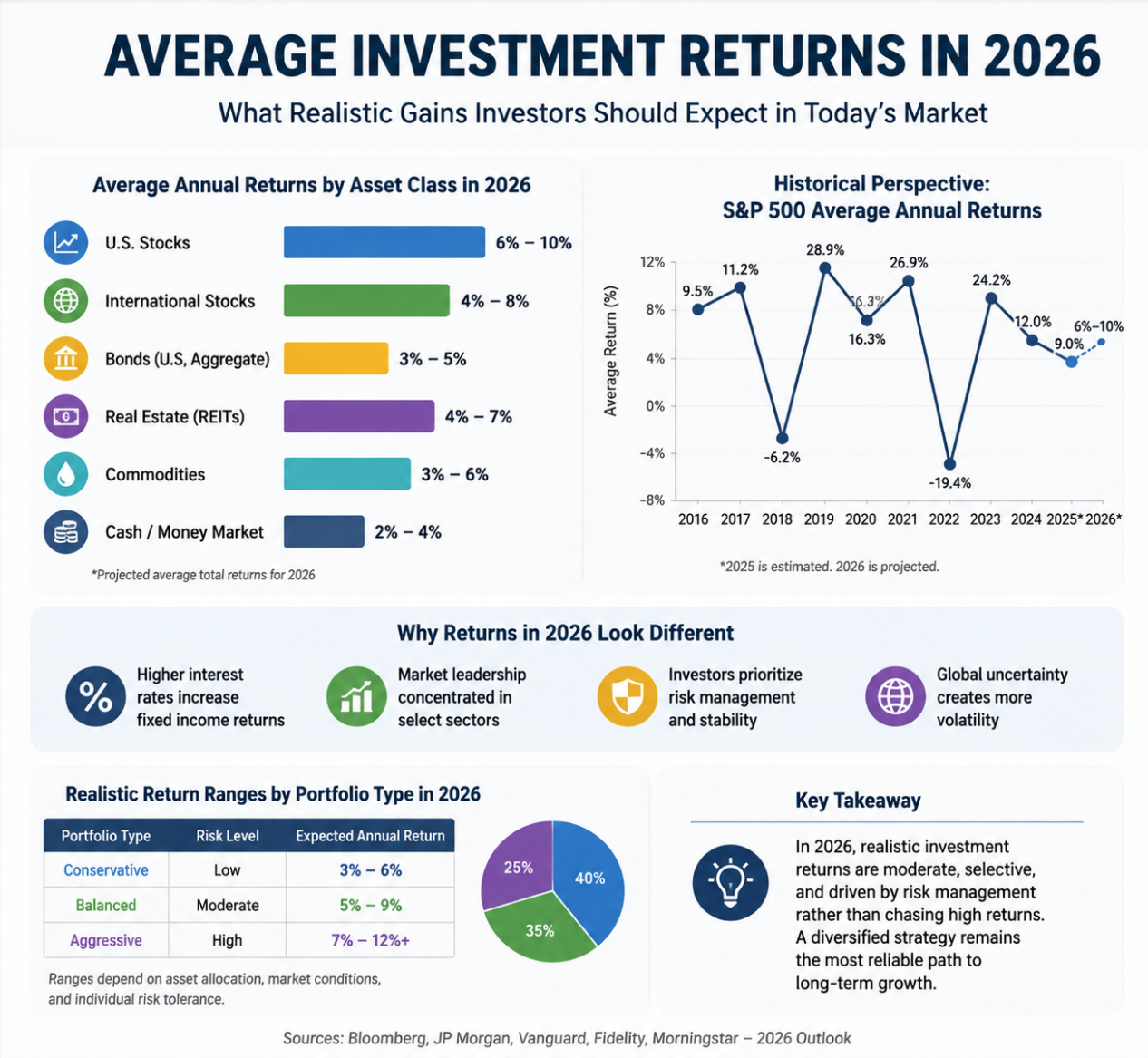
Unlike earlier high-growth periods, returns in 2026 are more selective and uneven across sectors.
📉 Stock Market Returns: More Normalized Growth
Historically, long-term stock market returns in the U.S. average around 7%–10% annually.
However, in 2026:
Gains are more concentrated in specific sectors (AI, energy, healthcare)
Broader market growth is more moderate
Volatility remains elevated compared to pre-2020 levels
Many investors are now shifting from “growth chasing” to risk-adjusted returns.
🏦 Fixed Income & Interest-Based Investments
With interest rates stabilizing at higher levels compared to previous years, fixed-income investments have regained attention.
Common instruments include:
Treasury bonds
High-yield savings accounts
Money market funds
Corporate bonds
In 2026, these instruments offer:
Lower risk, but also moderate and predictable returns.
📊 Why Investment Expectations Have Changed
One of the biggest shifts in 2026 is psychological:
Investors are now more focused on:
Capital preservation
Inflation-adjusted returns
Long-term stability
Rather than:
Short-term high-risk gains
Speculative growth assets
This shift is largely driven by previous market cycles and ongoing economic uncertainty.
📈 Realistic Return Ranges in 2026
While actual returns vary, most diversified portfolios in 2026 tend to fall into these ranges:
Conservative portfolios: 3%–6% annually
Balanced portfolios: 5%–9% annually
Aggressive portfolios: 7%–12%+ (higher volatility)
👉 These ranges depend heavily on market timing, asset allocation, and risk exposure.
❓ FAQ
What is a realistic investment return in 2026?
Most diversified investors can expect between 5% and 9% annually depending on risk level.
Are high returns still possible in 2026?
Yes, but they are more concentrated in specific sectors and come with higher volatility.
Are bonds a good investment in 2026?
Bonds have regained attractiveness due to higher interest rates and stable income potential.
What is the safest investment type?
Government bonds and diversified index funds are generally considered lower risk options.
People researching investment returns in 2026 often also search for: