
If you feel like living in the United States in 2026 has become more expensive than ever, you are not alone.
Even though inflation has cooled compared to the peak years, most American households are still dealing with a simple reality:
Housing, food, and electricity costs are still rising faster than wages.
Many families searching for answers are asking the same questions:
Why is the cost of living still so high in 2026?
Which expenses are increasing the most?
Is inflation actually going down or just slowing?
The truth is more complex than headline inflation numbers suggest.
📊 What “Cost of Living” Really Means in 2026
The cost of living refers to the total amount needed to maintain a basic standard of life, including:
Housing (rent or mortgage)
Food and groceries
Electricity and utilities
Transportation
Healthcare
Insurance and taxes
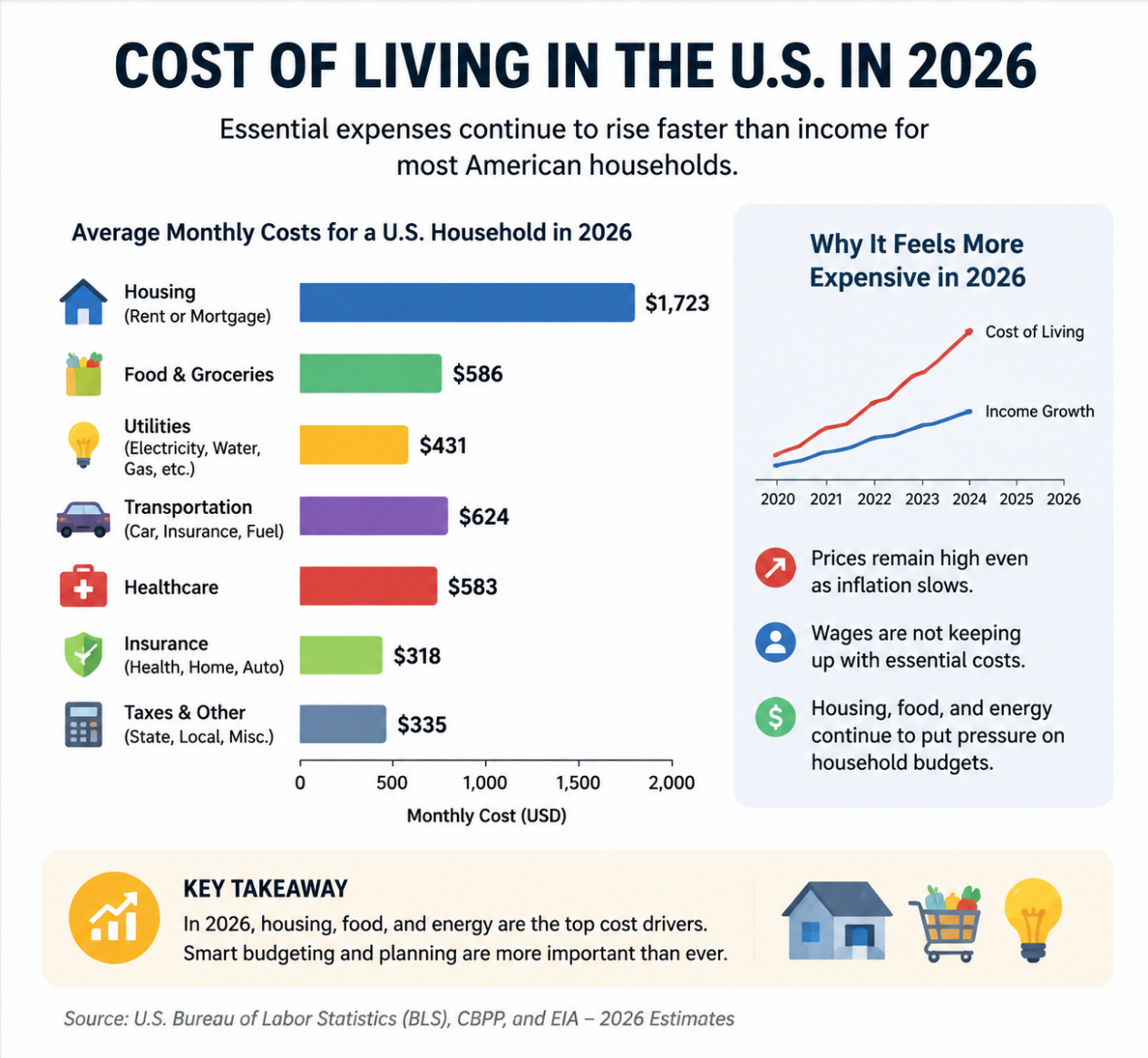
In 2026, the problem is not just inflation — it is price stickiness in essential categories.
Even when inflation slows overall, essentials remain expensive.
🏠 Housing Costs: The Biggest Driver of Pressure
Housing continues to be the largest financial burden for American households.
What is happening in 2026:
Rent prices remain high in most metro areas
Mortgage rates are still elevated compared to pre-2020 levels
Home affordability remains low for first-time buyers
In many cities, housing alone can take up a large portion of monthly income, leaving less room for savings.
👉 A key issue is that housing supply has not kept up with demand, especially in urban and suburban growth areas.
🍎 Food & Grocery Prices: Still Rising Slowly but Constantly
Food inflation has slowed compared to previous years, but prices are still moving upward.
In 2026:
Grocery bills remain higher than pre-2020 levels
Eating out is significantly more expensive than home cooking
Families are shifting toward budget brands and bulk purchasing
Even small weekly increases accumulate into noticeable annual pressure.
⚡ Energy & Electricity Bills: The Hidden Pressure Point
One of the most underestimated cost drivers in 2026 is energy.
Electricity and utility bills continue to rise due to:
Higher infrastructure costs
Seasonal extreme heat and cooling demand
Regional pricing differences
A growing number of households report that energy bills are becoming a “second rent payment” during peak summer and winter months.
🚗 Transportation & Daily Mobility Costs
Transportation remains sensitive to:
Fuel price fluctuations
Insurance increases
Vehicle maintenance costs
Even households that already own cars are paying more to simply maintain mobility in 2026.
📉 Why People Feel Worse Even When Inflation Slows
This is the key contradiction in 2026:
Even if inflation rates improve, prices do not go back down.
That means:
Income grows slowly
Prices stay elevated
Budget pressure accumulates over time
Recent consumer data shows that many Americans still report cost-of-living stress as their main financial concern despite improved inflation readings.
🧾 FAQ
Is the cost of living still increasing in the U.S. in 2026?
Yes, but the increases are concentrated in housing, energy, and food rather than all categories equally.
Why does it feel more expensive even if inflation slows?
Because prices remain high — slower inflation does not mean prices decrease.
What is the biggest expense for Americans in 2026?
Housing remains the largest monthly expense for most households.
Which states are cheaper to live in?
Lower-cost regions typically include parts of the Midwest and Southern U.S., where housing and taxes are more affordable.
If you are researching this topic, people often also search for: